This is the second post looking at our long road trip to the beautiful Orkney Islands. The first post looked at the islands' unique Neolithic heritage. This post will look at some of the more recent historic sites we visited, and some of the natural beauty on offer.
One of the most unusual sites on Orkney is the 'Italian Chapel' near the Churchill Barriers. Built by Italian POWs in 1943 from Nissen Huts to serve their nearby POW camp, the chapel is both an amazing survival and the interior a wonderful piece of artwork in its own right - particularly the painted 'stonework'.
The capital of Orkney, Kirkwall, contains a number of interesting historical sights, as well as being a very nice place to explore and do a bit of shopping in. The cathedral is the star attraction, with its solid red sandstone Romanesque architecture.
A particularly unusual feature of the cathedral was the sheer number of 17th Century tombstones lined up inside featuring variations on a skull and crossbones motif. While no doubt intended to carry a form of 'as I am, so you shall be' message, it was striking to see so many in one building and so many with such wonderful quality carvings. Here are just a small selection.
Kirkwall also boasts two historic palaces - the Bishop's Palace and the Earl's Palace. We actually arrived quite late in the day and just got inside before last entry so didn't have as long to explore as we might have liked.
Essentially, the Bishop's Palace is the older of the two, and dates to the 12th Century. The adjacent Earl's Palace was begun in the early 17th Century and was the replacement for the Bishop's Palace, by then seen to be too small and old fashioned. The Earl's Palace was built in French Renaissance style and the grandeur it once had is still clear to see.
Of course, one of the great joys of Orkney is simply enjoying its natural beauty, be it on the endless coastline at Yesnaby or at the top of a viewing point like Wideford Hill. To finish, here are some of my favourite images taken while travelling around.
Its rather odd that, despite blogging about a few different Chinese museums I've visited, I've never yet posted anything about one of the many visits I've made to my favourite one - the Jinsha Site Museum in Chengdu. Of course, if you've read the title of this post, you might have realised that this post isn't about that museum either! One day, folks, I promise I will...
Most Chinese provincial capitals seem to contain a museum telling the story of their wider province and Chengdu, the capital of Sichuan province, is no exception. Of course, with a population of over 80 million people, its rather a large area to cover in one museum so the approach is to look at things by large 'subject' halls rather than by trying to tell a chronological story. Architecturally the museum ticks all the boxes of the modern Chinese museum design book. A large, clean stone and glass building with a sweeping roofline, inside which is a large central atrium with circular walkways on each floor, and exhibition halls projecting off symmetrically.


Before heading inside the museum, though, something definitely caught my eye outside - a large lorry. Although I initially wondered why on earth someone had been allowed to park a lorry right outside the front door, all soon became clear. In a great example of how progressive Chinese museums can be, and clearly in response to the question of how you relate to a province-wide audience, the lorry is in fact a wonderfully branded mobile museum. The design of the lorry was particularly good, with expanding sides to create a walkway when parked. Sadly, it was locked up and I couldn't get inside to see what stories were being told, how the objects were being secured and indeed what the object selection had been from a security and environment point of view.
Inside the museum the displays are divided into a number of halls, which I'll now explore one at a time:
Gallery of Bronze ware
This gallery examines bronzework (mainly in the form of vessels and weaponry) from the Xia, Shang and Zhou dynasties. The galleries contain a minimal number of objects, displayed in well lit cases and with small but neat and bilingual object labels. As seems normal for Chinese museums, there is no visible environmental monitoring within cases. The quality of the objects is first rate, however, and there are some neat display solutions such as the use of magnifying glasses and mirrors to see both sides of seals.
Gallery of Ceramics
Just like it says on the tin, this gallery looks at the development of ceramics in the province, mainly in the Han and Song dynasties. The focus is very much on the more unusual and decorative vessels and tomb figurines here, rather than the everyday vessels used by the majority of people. There is a nice section on changing kiln technology, however, that most Chinese museums would ignore entirely.
Zhang Daqian's Art Gallery
The most unusual gallery in the museum is one dedicated to the works of a single artist. Zhang Daqian (1899 - 1983) comes across as something of an eccentric character. He was a Buddhist monk in his early life, but would later move abroad and exhibited his paintings in New York in the 1950s. Of particular interest, though, is his time spent recording the Buddhist frescoes in the caves at Dunhuang in the 1940s. These frescoes were damaged and stolen before and after then, and his paintings serve as a valuable historic record alongside being works of art. His work is much more varied than that, however, as the images below show. One thing I liked was the quote that he buried all of his used brushes in his garden as he formed an attachment with them. He even erected a monument to his 'tomb of brushes'!
Gallery of Tibetan Buddhism
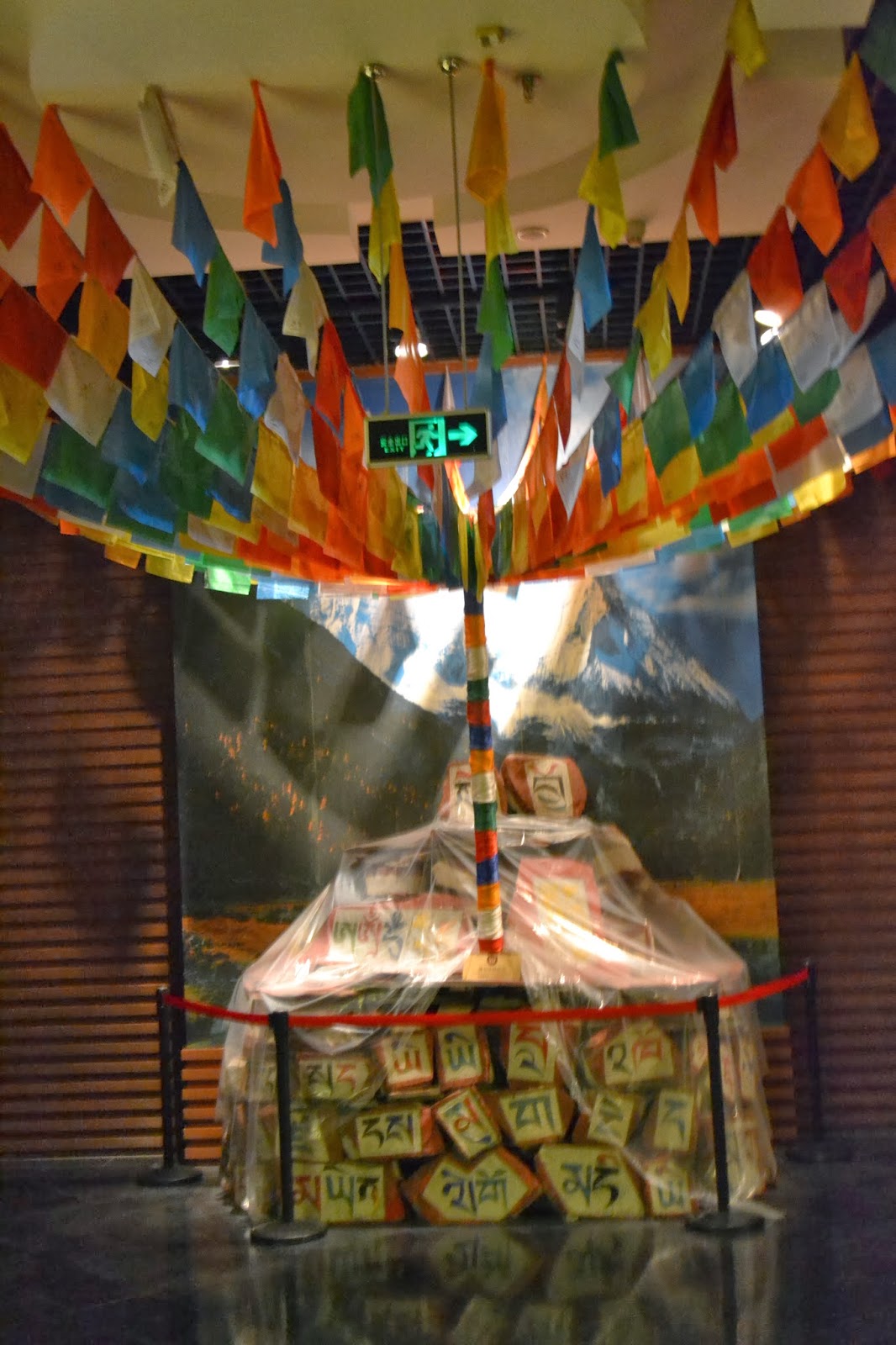
Given that Sichuan borders Tibet, and many thousands of people of Tibetan ethnicity live well within the boundaries of Sichuan, it is understandable that a gallery is dedicated to Buddhist art. Despite the wealth of interesting objects, sadly I think this is one gallery that underwhelms, as it doesn't really attempt to provide a deeper understanding of Buddhism. Also, not at all surprising in a Chinese museum, social issues are avoided at all costs...
Gallery of Sichuan Crafts
This mixed gallery definitely contains everything that wouldn't fit in any other gallery! A strange but fascinating mix of glassware, rhino horn cups, bamboo carvings, shadow puppets and embroidery is displayed, some of which are fascinating in their scale, and some of the bamboo carving in particular is of wonderful quality and detail.
Pottery and Stone Carvings Gallery of Han Dynasty in Sichuan
This ponderously-titled gallery does at least let you know what's contained within - a selection of ceramic tomb models and stone carvings from the Han Dynasty. I confess I was starting to get gallery fatigue by this point, but some of the ceramic tiles were fun, and displayed nicely with rubbings so the design could be better seen. Look out for the one with the voyeur enjoying himself behind a tree - that one would even make the Romans blush!