Last year I entertained myself during the quiet evenings by writing a short story about Roman Lincoln. Earlier this year the bug bit me again and I penned a follow up story. I confess I actually finished it some months ago but have only now got around to tidying it up and putting it on the blog.
So, if anyone is interested, you can now download the second exciting story of Caradoc the blacksmith by clicking here. The 'writing' tab at the top of the page has a little bit more detail, and a link to both stories.
This second story features a series of major grain thefts blighting Lindum Colonia, and sees our hero going on a journey to try and discover the culprit, and ending up getting himself and a new young friend in some hot water as the repercussions go right to the top of the social order.

Showing posts with label lincoln. Show all posts
Showing posts with label lincoln. Show all posts
Saturday, 1 November 2014


Tuesday, 3 June 2014
A new lease of life for Lincoln's Newport Arch
Lincoln's most famous Roman relic has just been reopened following months of repair and restoration. Newport Arch, the 3rd Century northern gateway into Roman Lincoln, is renowned for being the only Roman archway in Britain still used by traffic - despite a few vehicles trying to end its long life over the years. In fact, it hasn't just been clumsy driving that has threatened the arch's existence. At certain points, certain people seem to have cared very little about it. I'm reminded of a quote from 1774:
Despite some minor grumbles from local businesses over the time the work has taken and the complete closure of the arch being required, it can't be denied that the restoration was urgently needed. The arch had already been placed on the English Heritage Buildings at Risk register in 2012 and the City Council deserve credit for making the long term stability of the arch a priority and getting the work done. Despite generous grants from WREN, the project still cost a not inconsiderable £140,000.
So now that the arch is completely open again, let's hope its still standing and continuing to be one of Lincoln's treasures in another 1,700 years.


'Sir Cecil Wray, the Solomon of these parts, I much fear is doing all he can to pull down the finest Roman antiquity in the Island, a Roman arch belonging to the old Roman station Lindum, near Lincoln, and all this to break apieces to mend the turnpike roads.'
Despite some minor grumbles from local businesses over the time the work has taken and the complete closure of the arch being required, it can't be denied that the restoration was urgently needed. The arch had already been placed on the English Heritage Buildings at Risk register in 2012 and the City Council deserve credit for making the long term stability of the arch a priority and getting the work done. Despite generous grants from WREN, the project still cost a not inconsiderable £140,000.
So now that the arch is completely open again, let's hope its still standing and continuing to be one of Lincoln's treasures in another 1,700 years.
Tuesday, 23 July 2013
Tales of Roman Lincoln - dipping my toe into writing
The closest I usually get to creative writing is either posting on this blog or pulling together new exhibition labels at the museum, but I was inspired some months ago to write a short adventure story based around somewhere I have a particular interest in - Roman Lincoln.

I've created a new tab at the top of this blog (imaginatively titled 'writing'), which explains a little about the idea behind it and the inspiration for the main character, a Romano-British blacksmith called Caradoc. The title 'Concussio' is Latin word, meaning 'extortion', and gives a little hint as to the plot.
You can get the story in PDF format by going to the writing tab, or clicking on the link below.
If you feel inspired to give it a little read, I'd be grateful for any feedback in the comments below. I'm certainly no author (so please be kind!) and I'm sure the influence of the authors I read will be obvious, but it was fun to write and I may well feel inspired to come back and add to the series at some point.
Thursday, 4 July 2013
Lincoln Cathedral's graffiti problem
Whilst at Lincoln Cathedral this afternoon, I found myself looking at a part of the building I don't often pay much attention to - the small vaulted alcove on the outside of the south side of the building, by the south transept.
Sadly, it seems like some other people certainly do spend some time in this secluded spot judging from the amount of graffiti, some sadly very recent, carved into the ancient walls. Presumably the area has become something of a late night hang-out for a certain element of society, and judging by the same names appearing multiple times the same group are responsible. Although Hitler himself may not actually have been present (see photo 7), it seems a shame that such vandalism, clearly going on for some time, cannot be stopped and the offenders punished.
This sort of thing seems particularly apt when considering the recent furore over Chinese graffiti at the Egyptian temple at Luxor - is this vandalism closer to home any more acceptable? I would definitely say not.


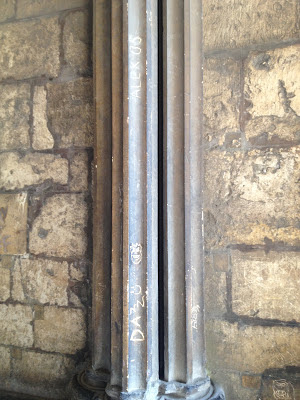


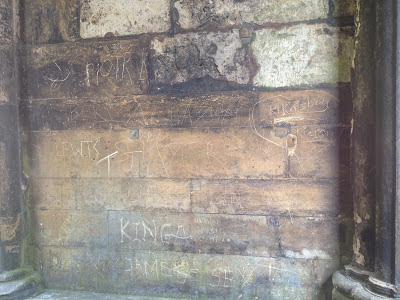
Sadly, it seems like some other people certainly do spend some time in this secluded spot judging from the amount of graffiti, some sadly very recent, carved into the ancient walls. Presumably the area has become something of a late night hang-out for a certain element of society, and judging by the same names appearing multiple times the same group are responsible. Although Hitler himself may not actually have been present (see photo 7), it seems a shame that such vandalism, clearly going on for some time, cannot be stopped and the offenders punished.
This sort of thing seems particularly apt when considering the recent furore over Chinese graffiti at the Egyptian temple at Luxor - is this vandalism closer to home any more acceptable? I would definitely say not.


Wednesday, 13 February 2013
Thoughts on producing a museum multimedia guide
The life of a modern museum curator is anything but dull, and new projects have a tendency to spring up at short notice (usually when funding becomes available) and take over your life. One such project for me has been the development of new handheld multimedia guides for my museum. I say 'for me' in a rather egotistical way, but of course the whole process has involved numerous colleagues and the company we employed to actually produce them. This post, however, is my personal take on the process and my role in proceedings. Putting some of these thoughts into words has been inspired by the talk I was recently asked to give about the process to the Midlands Federation of Museums and Galleries.
Museums are funny places when it comes to technology, and I think its fair to say that on the whole they are not usually near the cutting edge, preferring instead to hang back and invest valuable resources on technology that is older and more proven. Modern multimedia guides, though, move a little closer to that edge. Although not utilising features such as augmented reality quite yet the smartphone interfaces, screen resolution and production values on offer certainly make the product feel on a par with more commercial entertainment products. For a regional museum, I admit to being quite proud of the quality of product we have produced.
But its one thing to want to wow visitors with funky technology, interactive games and objects coming to life in your hand, its quite another to actually produce the content that will consistently, cogently and comprehensively deliver that experience. And as a curator, that task lands squarely on your shoulders. Fun...
Because when you start to think about it, every museum gallery is (or bloody well should be) a mine of information and inspiration, of stories begging to be told - and particularly of stories that are difficult to tell in a 30 word object label. Many therefore inevitably remain untold. But visitors' attention spans are only so long. With the best will in the world, no-one is going to commit themselves to an 8 hour slog around your gallery listening intently to every word you have to say. Our multimedia guides, on the advice of those who do this for a living, consist of an adult tour and a children's tour, each just over an hour long.
'Fair enough' I hear you say. But the gallery I deal with covers the whole archaeology of the very large county of Lincolnshire. Imagine being told that you've got an hour to stand up and talk to a random group of people off the street, most of whom have no prior knowledge of the subject. Your job is to tell them, in an interesting and engaging way and with reference to a series of objects placed in front of them, the entire history of Lincolnshire. You have to explain the Ice Ages and the scant evidence of the earliest human inhabitation. You have to talk about the development of farming and explain what round barrows are; about Iron Age votive deposition and early coin production; about the Roman invasion and life in an important Roman city; about Anglo Saxon burial customs and placename evidence, about Viking political organisation and trade; about Medieval monastic life, the feudal system and the impact of the English Civil War. All in one hour. Suddenly the task doesn't sound quite so easy...
In essence, there is a matter of seconds to not only describe each object you've chosen to highlight, but place it within its local, national or international context, reference wider social themes, demonstrate how the object was made or used and show the small decorative details that people miss when it is sitting behind glass - all while not boring or confusing the audience, being consistent with other interpretation, and trying to reflect accurate modern scholarship.
Needless to say, a clear picture of the overarching story you want to tell is essential from the outset. Colleagues will attest to the howls of frustration coming from my general direction as my initial long list of objects and themes was whittled down further and further to meet requirements, and I confess it is a hard process to go through as everything has a story that you want visitors to know. However, having come through that process I know it was the right thing to do - that a careful selection of objects to allow enough time to tell the right stories is better than including masses of objects but having no time to provide anything but the briefest of descriptions of them, most of which is simply a repeat of the label text.
A multimedia guide cannot sit alone in the gallery. It has to be part of the interpretation strategy. For a historic house, such a guide might be the only form of interpretation a visitor gets aside from talking to room stewards, but in a museum we already have masses of interpretation. Wall panels and object labels already give descriptions of objects and sites, and the multimedia guide shouldn't repeat what is already being said - to do that would be a complete waste of both resources and opportunity. The multimedia guide, for me, was a chance to go beyond the printed interpretation - to give visitors a personal tour, as if being guided round by a human being, pointing out the quirky facts and opinions that make history enjoyable and memorable. In short, I wanted it to have a personality and a sense of humour. I find our history exciting, and I want our visitors to share in that feeling.
Also important is a sense of equity across the gallery. Our archaeological tours cover a vast span of time (around 300,000 years), and it is important that there is a balance between the periods. I'm a Romanist, but it would be unseemly to let that bias show and neglect other periods - I think in that aim we've succeeded rather well. Of course we'll never win, and I fully expect that we'll be chastised from certain people for not covering their pet subject in enough detail or, God forbid, at all. Sadly, some never realise that such work has to be done for the benefit of tens of thousands of people, not to meet the personal interests of a single person.
It was important for the tours to be flexible, so that visitors who decided to abandon the chronological route (or simply got lost or confused and missed bits) could always know what was going on. This meant ensuring that each piece flowed neatly when viewed 'in order', but didn't jar when seen individually or randomly. Just another thing to bear in mind during the development and scriptwriting...
One important early decision was who should guide the visitor around. A personality? Museum curators and other staff members? A professional actor or narrator? We quickly decided against a personality as a gimmick we'd regret in a few years, and settled on a professional actor and cameo interviews with staff and relevant external specialists. Although I wouldn't normally give a plug at a time like this, I will do in the case of the actor we chose - Ian Houghton. Apart from being an excellent actor, a lovely bloke and a pleasure to work with, the main thing for me is that he understood what this meant for us and cared about our product, our museum and our visitors. I think that comes through on the finished product, and I'm absolutely certain that not every actor would have given us that.
The adult tours are therefore presented by a combination of characters from each period, acted in the 1st person, and a female narrator's voice over. The children's tours are presented entirely by a modern-day character called Archie who starts each period in the modern day and travels back in time to appear in costume as an historical character, but always retaining his modern knowledge. Both tours feature the staff and expert cameos and a selection of games and interactive pieces.
One of the most difficult things during the development process is simply to keep on top of it all - to meet all the deadlines but make sure that everything is accurate and keeping the balance you wanted. Its so easy when checking through 100 pages of script to miss the odd word, but when you later hear it spoken by the actor you cringe and wonder how you let a minor inaccuracy or awkward phrase slip through. Hopefully there aren't many of those in the finished product, but they are a constant worry as once the product is released on the public they tend to get noticed and, unlike an object label, cannot be corrected easily or cheaply.
So will all this hard work and multimedia sexiness lead to a whole new era in the experience of museum visitors? Hopefully so, but only time will tell...
Museums are funny places when it comes to technology, and I think its fair to say that on the whole they are not usually near the cutting edge, preferring instead to hang back and invest valuable resources on technology that is older and more proven. Modern multimedia guides, though, move a little closer to that edge. Although not utilising features such as augmented reality quite yet the smartphone interfaces, screen resolution and production values on offer certainly make the product feel on a par with more commercial entertainment products. For a regional museum, I admit to being quite proud of the quality of product we have produced.
But its one thing to want to wow visitors with funky technology, interactive games and objects coming to life in your hand, its quite another to actually produce the content that will consistently, cogently and comprehensively deliver that experience. And as a curator, that task lands squarely on your shoulders. Fun...
Because when you start to think about it, every museum gallery is (or bloody well should be) a mine of information and inspiration, of stories begging to be told - and particularly of stories that are difficult to tell in a 30 word object label. Many therefore inevitably remain untold. But visitors' attention spans are only so long. With the best will in the world, no-one is going to commit themselves to an 8 hour slog around your gallery listening intently to every word you have to say. Our multimedia guides, on the advice of those who do this for a living, consist of an adult tour and a children's tour, each just over an hour long.
'Fair enough' I hear you say. But the gallery I deal with covers the whole archaeology of the very large county of Lincolnshire. Imagine being told that you've got an hour to stand up and talk to a random group of people off the street, most of whom have no prior knowledge of the subject. Your job is to tell them, in an interesting and engaging way and with reference to a series of objects placed in front of them, the entire history of Lincolnshire. You have to explain the Ice Ages and the scant evidence of the earliest human inhabitation. You have to talk about the development of farming and explain what round barrows are; about Iron Age votive deposition and early coin production; about the Roman invasion and life in an important Roman city; about Anglo Saxon burial customs and placename evidence, about Viking political organisation and trade; about Medieval monastic life, the feudal system and the impact of the English Civil War. All in one hour. Suddenly the task doesn't sound quite so easy...
In essence, there is a matter of seconds to not only describe each object you've chosen to highlight, but place it within its local, national or international context, reference wider social themes, demonstrate how the object was made or used and show the small decorative details that people miss when it is sitting behind glass - all while not boring or confusing the audience, being consistent with other interpretation, and trying to reflect accurate modern scholarship.
Needless to say, a clear picture of the overarching story you want to tell is essential from the outset. Colleagues will attest to the howls of frustration coming from my general direction as my initial long list of objects and themes was whittled down further and further to meet requirements, and I confess it is a hard process to go through as everything has a story that you want visitors to know. However, having come through that process I know it was the right thing to do - that a careful selection of objects to allow enough time to tell the right stories is better than including masses of objects but having no time to provide anything but the briefest of descriptions of them, most of which is simply a repeat of the label text.
A multimedia guide cannot sit alone in the gallery. It has to be part of the interpretation strategy. For a historic house, such a guide might be the only form of interpretation a visitor gets aside from talking to room stewards, but in a museum we already have masses of interpretation. Wall panels and object labels already give descriptions of objects and sites, and the multimedia guide shouldn't repeat what is already being said - to do that would be a complete waste of both resources and opportunity. The multimedia guide, for me, was a chance to go beyond the printed interpretation - to give visitors a personal tour, as if being guided round by a human being, pointing out the quirky facts and opinions that make history enjoyable and memorable. In short, I wanted it to have a personality and a sense of humour. I find our history exciting, and I want our visitors to share in that feeling.
Also important is a sense of equity across the gallery. Our archaeological tours cover a vast span of time (around 300,000 years), and it is important that there is a balance between the periods. I'm a Romanist, but it would be unseemly to let that bias show and neglect other periods - I think in that aim we've succeeded rather well. Of course we'll never win, and I fully expect that we'll be chastised from certain people for not covering their pet subject in enough detail or, God forbid, at all. Sadly, some never realise that such work has to be done for the benefit of tens of thousands of people, not to meet the personal interests of a single person.
It was important for the tours to be flexible, so that visitors who decided to abandon the chronological route (or simply got lost or confused and missed bits) could always know what was going on. This meant ensuring that each piece flowed neatly when viewed 'in order', but didn't jar when seen individually or randomly. Just another thing to bear in mind during the development and scriptwriting...
One important early decision was who should guide the visitor around. A personality? Museum curators and other staff members? A professional actor or narrator? We quickly decided against a personality as a gimmick we'd regret in a few years, and settled on a professional actor and cameo interviews with staff and relevant external specialists. Although I wouldn't normally give a plug at a time like this, I will do in the case of the actor we chose - Ian Houghton. Apart from being an excellent actor, a lovely bloke and a pleasure to work with, the main thing for me is that he understood what this meant for us and cared about our product, our museum and our visitors. I think that comes through on the finished product, and I'm absolutely certain that not every actor would have given us that.
The adult tours are therefore presented by a combination of characters from each period, acted in the 1st person, and a female narrator's voice over. The children's tours are presented entirely by a modern-day character called Archie who starts each period in the modern day and travels back in time to appear in costume as an historical character, but always retaining his modern knowledge. Both tours feature the staff and expert cameos and a selection of games and interactive pieces.
One of the most difficult things during the development process is simply to keep on top of it all - to meet all the deadlines but make sure that everything is accurate and keeping the balance you wanted. Its so easy when checking through 100 pages of script to miss the odd word, but when you later hear it spoken by the actor you cringe and wonder how you let a minor inaccuracy or awkward phrase slip through. Hopefully there aren't many of those in the finished product, but they are a constant worry as once the product is released on the public they tend to get noticed and, unlike an object label, cannot be corrected easily or cheaply.
So will all this hard work and multimedia sexiness lead to a whole new era in the experience of museum visitors? Hopefully so, but only time will tell...
Saturday, 2 February 2013
Roman Lincoln and the north/south divide
The division between the north and the south in modern England is a subject that rears its head from time to time in the media. The issues the debates centre around tend to be ones of money, social conditions, family values and political voting demographics rather than of mere geography.
Some places are clearly defined as to their position in this debate. Manchester is a northern city, Oxford is a southern city. But what of the nebulous bit of England in the middle - the oft sidelined and much maligned 'Midlands'? Lincoln is very much a Midlands city geographically, even though it is about level with Liverpool (somewhere no one would categorise as either southern or Midlands), but most Lincoln residents would probably say they were more northern than southern.

But what about in Roman Britain? Where did the citizens of Lindum Colonia place themselves in the context of the province of Britannia? Can we even suggest that people thought of themselves in such terms?
We have to begin by going back before the Roman invasion, to the Iron Age Corieltavi tribe. The Corieltavi are often categorised as the most northerly of the south-eastern group of tribes that might be termed 'more civilised' to Roman eyes. This 'civilisation' effectively relates to a greater degree of trade and contact with the continent and the production of coinage.
At the point of the Roman invasion, then, the Corieltavian people living in and around what would become Lincoln, unaware of the changes that would soon come upon them, might well have considered themselves more akin to their southern neighbours than those north of the Humber, though important trade links undoubtedly existed with the north, as coin distributions attest.
The position of Lincoln at the northern edge of a 'civilized south eastern' corner of the country is reinforced in the early years of the Roman occupation, when the Ninth Legion had advanced as far as southern Lincolnshire. The sequencing of the Roman fortresses at Lincoln is still open to debate. The more famous fortress on top of the hill was a Neronian foundation, constructed in the AD60s, but there is the tantalising prospect of an earlier fortress at the south of the city, based mainly on tombstone finds. The Fosse Way, running diagonally southwest from Lincoln to Exeter became the first established frontier of the new province, placing Lincoln on the very edge of the Roman Empire but most definitely within it.
The next point at which we can reflect on Lincoln's relative position within the province is in the early AD200s. The Emperor Septimius Severus, desirous to reduce the power that the Governor of Britain possessed following the revolt of Clodius Albinus, decided to split the province into two, although the actual split seems to have been enacted by Severus' son Caracalla.
The two provinces created were known as Britannia Superior (the south) and Britannia Inferior (the north). Although the modern English meanings of these names can be taken to refer to a hierarchy of importance, the names in Latin simply mean 'upper' and 'lower'. However, it would be surely be disingenuous to suggest that the wealthier, less rebellious south wasn't the favourable province to govern.
 The province to which Lindum belonged was unknown until the 1928 discovery of an altar in Bordeaux. Set up in AD237 by Briton called Marcus Aurelius Lunaris, it expressed thanks to the goddess Tutela for a safe voyage across the Channel. Lunaris was a priest of the Imperial Cult at both Lincoln and York, which he helpfully stated were both in the province of Britannia Inferior.

Despite previous cultural affiliations with the south of Britain, Lindum was now firmly established as one of the southernmost settlements of the new northern province. It is also worth noting that it was in the reign of Caracalla that Roman citizenship was extended to everyone living in the Empire, so the special status afforded those living in a Colony such as Lincoln became universal.
The final major alteration to provincial governance occurred in around AD300. As part of an Empire-wide reorganisation under the Emperor Diocletian, the province was divided into four parts. Although the new look and structure of the province is often presented in books and on the web as established fact, the evidence is actually rather scant and the interpretation quite conjectural. For example, the boundaries of the four provinces are pure guesswork, and the capitals of them based mostly on those proposed boundaries.
The most commonly used interpretation sees the province divided as in the map below, with Lincoln becoming the capital of 'Flavia Caesariensis'.

An interesting site just to the east of the Roman walled city is the site known as Greetwell Villa. This large rural estate was discovered and destroyed by Victorian quarrying, but the records that were made at the time show a home on a palatial scale with the longest corridor known from Roman Britain. Could this have been the home of the provincial Governor of Flavia Caesariensis?
So the conclusion of all this? Although we can never know the feelings of the citizens of Roman Lincoln, it is possible that a sense of not quite truly belonging to either north or south may be older than we imagine. While definitely set apart from the rebellious tribes of the north, and perhaps even looking disdainfully on their northern neighbours, the people of Lincoln may equally have felt distinctly provincial when faced with the wealth and continental interaction of their southern counterparts.
Some places are clearly defined as to their position in this debate. Manchester is a northern city, Oxford is a southern city. But what of the nebulous bit of England in the middle - the oft sidelined and much maligned 'Midlands'? Lincoln is very much a Midlands city geographically, even though it is about level with Liverpool (somewhere no one would categorise as either southern or Midlands), but most Lincoln residents would probably say they were more northern than southern.

But what about in Roman Britain? Where did the citizens of Lindum Colonia place themselves in the context of the province of Britannia? Can we even suggest that people thought of themselves in such terms?
We have to begin by going back before the Roman invasion, to the Iron Age Corieltavi tribe. The Corieltavi are often categorised as the most northerly of the south-eastern group of tribes that might be termed 'more civilised' to Roman eyes. This 'civilisation' effectively relates to a greater degree of trade and contact with the continent and the production of coinage.
At the point of the Roman invasion, then, the Corieltavian people living in and around what would become Lincoln, unaware of the changes that would soon come upon them, might well have considered themselves more akin to their southern neighbours than those north of the Humber, though important trade links undoubtedly existed with the north, as coin distributions attest.
The position of Lincoln at the northern edge of a 'civilized south eastern' corner of the country is reinforced in the early years of the Roman occupation, when the Ninth Legion had advanced as far as southern Lincolnshire. The sequencing of the Roman fortresses at Lincoln is still open to debate. The more famous fortress on top of the hill was a Neronian foundation, constructed in the AD60s, but there is the tantalising prospect of an earlier fortress at the south of the city, based mainly on tombstone finds. The Fosse Way, running diagonally southwest from Lincoln to Exeter became the first established frontier of the new province, placing Lincoln on the very edge of the Roman Empire but most definitely within it.
The next point at which we can reflect on Lincoln's relative position within the province is in the early AD200s. The Emperor Septimius Severus, desirous to reduce the power that the Governor of Britain possessed following the revolt of Clodius Albinus, decided to split the province into two, although the actual split seems to have been enacted by Severus' son Caracalla.
The two provinces created were known as Britannia Superior (the south) and Britannia Inferior (the north). Although the modern English meanings of these names can be taken to refer to a hierarchy of importance, the names in Latin simply mean 'upper' and 'lower'. However, it would be surely be disingenuous to suggest that the wealthier, less rebellious south wasn't the favourable province to govern.


The final major alteration to provincial governance occurred in around AD300. As part of an Empire-wide reorganisation under the Emperor Diocletian, the province was divided into four parts. Although the new look and structure of the province is often presented in books and on the web as established fact, the evidence is actually rather scant and the interpretation quite conjectural. For example, the boundaries of the four provinces are pure guesswork, and the capitals of them based mostly on those proposed boundaries.
The most commonly used interpretation sees the province divided as in the map below, with Lincoln becoming the capital of 'Flavia Caesariensis'.

So the conclusion of all this? Although we can never know the feelings of the citizens of Roman Lincoln, it is possible that a sense of not quite truly belonging to either north or south may be older than we imagine. While definitely set apart from the rebellious tribes of the north, and perhaps even looking disdainfully on their northern neighbours, the people of Lincoln may equally have felt distinctly provincial when faced with the wealth and continental interaction of their southern counterparts.
Wednesday, 16 January 2013
Venta Icenorum - Roman Caistor by Norwich
Sometimes you go and attend a talk and its very nice. Interesting. Relaxing even. But other times you attend a talk and come home buzzing with new ideas and desperate to re-read every book you own on the subject to immerse yourself in it. I'm pleased to say that the talk I attended tonight was definitely in the latter camp.
It was the monthly lecture for the Society for Lincolnshire History and Archaeology (which if you're based in Lincolnshire and interested in history or archaeology there's really no excuse for not being a member of). The speaker was Dr Will Bowden of the University of Nottingham, and the subject that he spoke so entertainingly and eloquently about was the Caistor Roman Project.
Now, there are one or two Caistors to choose from in Britain, but this one is the Caistor in Norfolk, just south of Norwich - Venta Icenorum to the Romans. The site is a greenfield, owned by the Norfolk Archaeological Trust, and there has been an ongoing archaeological field school there since 2005.
The name 'Venta Icenorum' translates as 'the market of the Iceni'. I'm sure everyone know the Iceni as the tribe of Boudica and the famous revolt of AD60, but this famous connection has actually hampered the study of this important town as previous archaeologists have been desperate to link its development to the aftermath of the uprising, in the AD70s. One of the main research goals of Dr Bowden's project has been to understand the development of the town purely from the archaeological evidence, not from famous stories. It now appears that the main early development was slightly later, at the very end of the 1st Century and into the 2nd. Just as interesting is the end of the Roman period, as there is evidence that the Forum underwent a refurbishment in the 4th Century. Such investment is very rarely found, and perhaps speaks of the continued status of the town in the final years of Roman governance.
Another element of the story I found particularly fascinating is the question of just how built-up Roman towns actually were. The traditional view is that, within their imposing walls, sizeable Roman towns were densely packed with brick and tiled buildings, interspersed with fora, temples, basilicae and colonnades. While these classical edifices undoubtedly existed, it is becoming more and more obvious that the towns were far more hotchpotch than that, with timber and brick buildings growing up side by side, and growth happening organically rather than through large, planned urban developments. The existence of green spaces such as orchards or even brownfield sites within the walls are harder to prove archaeologically, but shouldn't be discounted.
A few finds from the site are worthy of mention. Firstly, on the religious front, a defixio was found in the area in 1981. A defixio is a lead tablet inscribed with a curse - asking a deity to punish another person for wronging them. This curse was a plea to Neptune, asking that the thief of a sizeable haul - a wreath, bracelets, a cap, a mirror, a head-dress, a pair of leggings and ten pewter vessels - be punished. Neptune was very generously offered the leggings if he assisted...
The second find is of a palaeolithic flint handaxe. Rather than being evidence of ancient occupation of the site, however, this was incorporated into the Forum building and seems to reflect the belief that prehistoric axes were actually the remains of lightning bolts ('fulgur' in Latin). By having one incorporated into the building, perhaps lightning wouldn't strike twice!
This wonderful project is up for an award - Current Archaeology Research Project of the Year, so click here to go and vote for it!
It was the monthly lecture for the Society for Lincolnshire History and Archaeology (which if you're based in Lincolnshire and interested in history or archaeology there's really no excuse for not being a member of). The speaker was Dr Will Bowden of the University of Nottingham, and the subject that he spoke so entertainingly and eloquently about was the Caistor Roman Project.
Now, there are one or two Caistors to choose from in Britain, but this one is the Caistor in Norfolk, just south of Norwich - Venta Icenorum to the Romans. The site is a greenfield, owned by the Norfolk Archaeological Trust, and there has been an ongoing archaeological field school there since 2005.
The name 'Venta Icenorum' translates as 'the market of the Iceni'. I'm sure everyone know the Iceni as the tribe of Boudica and the famous revolt of AD60, but this famous connection has actually hampered the study of this important town as previous archaeologists have been desperate to link its development to the aftermath of the uprising, in the AD70s. One of the main research goals of Dr Bowden's project has been to understand the development of the town purely from the archaeological evidence, not from famous stories. It now appears that the main early development was slightly later, at the very end of the 1st Century and into the 2nd. Just as interesting is the end of the Roman period, as there is evidence that the Forum underwent a refurbishment in the 4th Century. Such investment is very rarely found, and perhaps speaks of the continued status of the town in the final years of Roman governance.
Another element of the story I found particularly fascinating is the question of just how built-up Roman towns actually were. The traditional view is that, within their imposing walls, sizeable Roman towns were densely packed with brick and tiled buildings, interspersed with fora, temples, basilicae and colonnades. While these classical edifices undoubtedly existed, it is becoming more and more obvious that the towns were far more hotchpotch than that, with timber and brick buildings growing up side by side, and growth happening organically rather than through large, planned urban developments. The existence of green spaces such as orchards or even brownfield sites within the walls are harder to prove archaeologically, but shouldn't be discounted.
A few finds from the site are worthy of mention. Firstly, on the religious front, a defixio was found in the area in 1981. A defixio is a lead tablet inscribed with a curse - asking a deity to punish another person for wronging them. This curse was a plea to Neptune, asking that the thief of a sizeable haul - a wreath, bracelets, a cap, a mirror, a head-dress, a pair of leggings and ten pewter vessels - be punished. Neptune was very generously offered the leggings if he assisted...
The second find is of a palaeolithic flint handaxe. Rather than being evidence of ancient occupation of the site, however, this was incorporated into the Forum building and seems to reflect the belief that prehistoric axes were actually the remains of lightning bolts ('fulgur' in Latin). By having one incorporated into the building, perhaps lightning wouldn't strike twice!
This wonderful project is up for an award - Current Archaeology Research Project of the Year, so click here to go and vote for it!
Friday, 26 October 2012
Stories from The Collection #5 - 'Julia Maesa denarius ring bezel'
This is the fifth in a series of posts about recent acquisitions to the collections of The Collection: Art and Archaeology in Lincolnshire .

This article was published in the Autumn 2012 issue of ‘Lincolnshire Past and Present’ magazine, published by the Society for Lincolnshire History and Archaeology.

The Collection has recently acquired an unusual piece of Romano-British jewellery. The item in question is the bezel of a ring made from a Roman coin. Although the hoop of the ring is lost and only the bezel survives, it is nonetheless a most unusual and noteworthy addition to the county's archaeological collections.
 |
| Click to enlarge |
The bezel was discovered at Ulceby with Fordington, between Alford and Spilsby in March 2011 and reported as treasure. Although single coin finds are not classed as treasure under the definition in the 1996 Treasure Act, the conversion of this coin into an item of jewellery makes it eligible.
The coin is a silver denarius of Julia Maesa, minuted in Rome between AD220 and AD222. The obverse shows the draped bust of Julia Maesa, the reverse the figure of Felicitas, the personification of good fortune, holding a long caduceus whilst sacrificing over an altar. The reverse legend, now almost entirely lost, reads 'SAECVLI FELICITAS' - which optimistically translates as 'the happiness of the age'.
Julia Maesa herself was a member of one of the most interesting of Imperial dynasties, the Severans, and related to a number of Emperors. She was the sister-in-law of the Emperor Septimus Severus, grandmother of the Emperors Elagabalus and Alexander Severus and the aunt of the Emperor Caracalla and his murdered younger brother Geta. Far from being a passive figure, she actively involved herself in Imperial politics, particularly in her successful plot to overthrow the Emperor Macrinus and replace him with Elagabalus.
This type of reuse of a coin is extremely rare in Britain, though the practice is better evidenced on the continent. This example is particularly interesting for the fact that it is the reverse of the coin that was chosen for display in the ring, rather than the portrait. This strongly suggests that it was the fortuitous attributes of Felicitas that were sought or promoted by the wearer, and the Imperial imagery of decidedly lesser importance. Of course, the conversion from coin to ring may have occurred many years after the death of Julia Maesa herself, and after the coin had ceased to be legal tender.
The Collection is grateful to both the finder and the landowner for waiving their rights to a reward and donating the bezel to the museum.
Thursday, 20 September 2012
Lincoln - Apple mapping's forgotten city?
The launch of the new iPhone 5 and the accompanying iOS6 has been shouted loudly in recent weeks. As an iPhone 4S user, last night I spent two hours updating my phone to the new operating system. Among the things it promises are a whole new mapping app and the ability to perform local services searches that have previously only been available in the US.
The deficiencies of the new system are already becoming apparent - such as the town of Luton being relocated wholesale to Devon. But how does the new system fare for someone living in a small, out of the way city like Lincoln. Let's find out...
Ever one for serious activities, I thought I'd start out with the basics and ask it where my nearest Starbucks was (not that that particular brand of coffee is my favourite, I just thought it was a question it would surely get right). Sadly, despite there being THREE Starbucks in Lincoln, it seems that I actually have to travel to Louth to get a cuppa and a muffin.
.PNG)
Not to be accused of brand bias, I tried some more. Caffe Nero? Nope - have to go to Huddersfield. Costa? A shorter trip to Gainsborough is in order it seems. What about some great local independent coffee like Coffee Aroma? Sorry, never heard of it, guv.
OK, having failed to get a coffee, let's try something more cultural. A search in the mapping app for 'lincoln museum' should surely bring up a number of options. After all, Lincoln is well served, with both The Collection and the Museum of Lincolnshire Life offering local museumey goodness. Not according to the iPhone though. Apparently the Queen's Royal Lancers have a museum in Lincoln, though. Not only that, but they can be found in a Spar shop at the bottom of the High Street! Odd, I've worked in museums in Lincoln for ten years, but somehow never been to the Spar military museum...

Even specific searches are pretty poor, with 'the collection' returning a shop at the top of town, that even the mapping app is confused over the name of!
.PNG)
So far, so bad. Let's get sporty. Will the mighty Lincoln City FC be famous enough to feature in Apple's world? Thankfully yes, with a pin dropped right onto the centre spot of our beloved 12th Imp Sincil Bank Stadium.
.PNG)
With this glorious success under our belts, lets try to buy some electronics. Maybe go to PC World (on Tritton Road, for those that don't already know). No, apparently Doncaster hosts our local store (or, according to Apple, 'Duncaster' - they haven't even been able to spell the name right!). Bizarrely, it knows where the Lincoln Comet store is, but not the Curry's store only a few yards away, despite them being owned by the same company. Shopping at Curry's means once again going to Louth. At least you can get a coffee while you're there...
So, with only the Football ground and Comet successfully located in this unscientific little test, the only conclusion can be that Apple needs to get its act together quickly, or its new mapping will be useless to anybody outside of the big cities. At the minute, I certainly won't trust it when I'm out travelling.
Check out this Tumblr page for more worldwide Apple mapping madness.
The deficiencies of the new system are already becoming apparent - such as the town of Luton being relocated wholesale to Devon. But how does the new system fare for someone living in a small, out of the way city like Lincoln. Let's find out...
Ever one for serious activities, I thought I'd start out with the basics and ask it where my nearest Starbucks was (not that that particular brand of coffee is my favourite, I just thought it was a question it would surely get right). Sadly, despite there being THREE Starbucks in Lincoln, it seems that I actually have to travel to Louth to get a cuppa and a muffin.
.PNG)
Not to be accused of brand bias, I tried some more. Caffe Nero? Nope - have to go to Huddersfield. Costa? A shorter trip to Gainsborough is in order it seems. What about some great local independent coffee like Coffee Aroma? Sorry, never heard of it, guv.
OK, having failed to get a coffee, let's try something more cultural. A search in the mapping app for 'lincoln museum' should surely bring up a number of options. After all, Lincoln is well served, with both The Collection and the Museum of Lincolnshire Life offering local museumey goodness. Not according to the iPhone though. Apparently the Queen's Royal Lancers have a museum in Lincoln, though. Not only that, but they can be found in a Spar shop at the bottom of the High Street! Odd, I've worked in museums in Lincoln for ten years, but somehow never been to the Spar military museum...

Even specific searches are pretty poor, with 'the collection' returning a shop at the top of town, that even the mapping app is confused over the name of!
.PNG)
So far, so bad. Let's get sporty. Will the mighty Lincoln City FC be famous enough to feature in Apple's world? Thankfully yes, with a pin dropped right onto the centre spot of our beloved 12th Imp Sincil Bank Stadium.
.PNG)
With this glorious success under our belts, lets try to buy some electronics. Maybe go to PC World (on Tritton Road, for those that don't already know). No, apparently Doncaster hosts our local store (or, according to Apple, 'Duncaster' - they haven't even been able to spell the name right!). Bizarrely, it knows where the Lincoln Comet store is, but not the Curry's store only a few yards away, despite them being owned by the same company. Shopping at Curry's means once again going to Louth. At least you can get a coffee while you're there...
So, with only the Football ground and Comet successfully located in this unscientific little test, the only conclusion can be that Apple needs to get its act together quickly, or its new mapping will be useless to anybody outside of the big cities. At the minute, I certainly won't trust it when I'm out travelling.
Check out this Tumblr page for more worldwide Apple mapping madness.
Friday, 10 August 2012
On the cusp of the new football season
I haven't written about Lincoln City in quite a while now, and I think that's rather indicative of my general feelings about the state of the club and the disappointment of last season.
It seems almost blasphemous to write this, but I think that one reason that I enjoyed this summer is simply because I put the Imps out of my mind. I haven't really kept up with news of departures or new signings and I certainly haven't missed trudging down to the Bank on Saturday afternoons.
So it is with mixed feelings that I face the new season, despite my season ticket having been renewed early on in the summer. The new season should be a time of fresh beginnings and excitement at the unknown exploits that lie ahead. Sadly, the repeatedly poor performances of last season combined with the fact that we barely have the resources to buy teabags leaves me with no optimism that this year's team will be any good at all. While I don't doubt Holdsworth's honest intentions, I have grave doubts over his tactical abilities. I fear that the bottom half of the table will once again be City's domain and that attendances will continue to be embarrassingly low as the people of Lincoln refuse to pay premium prices for a bargain basement product.
To cap it all, this summer has also seen the club's official website given an overhaul (I suspect due to the removal of the Football League's sponsored template). Sadly, I've so far found it a badly designed mess to navigate and impossible to use on a mobile phone so that certainly hasn't improved my desire to keep checking and keeping up with changes at the club.
One change for the new season is the name of the stadium. Thankfully, the fundraising competition was won by the excellent '12th Imp' initiative, giving Sincil Bank the new name of 'The 12th Imp Sincil Bank Stadium'. Definitely better than I feared it might be, and definitely better than losing the traditional name to that of a sponsor.
Hopefully, of course, I can return to this post in a few month's time and curse my own grumpiness and lack of faith as we sit towards the top end of the table having played some half-decent football. If the last 18 years of supporting Lincoln have taught me anything, though, it's not to believe in miracles. Bring on Kidderminster...
11 August 2012 - post match addendum
So, with the Imps beating Kidderminster 1-0, am I going to be retracting the above comments? No. But I will admit to the side showing some potential, despite much more work clearly being needed.
It was good to see Taylor being given a chance, and with his bustling workrate he showed why he should have played a lot more last season. His strike partner Duffy didn't get a sniff of goal but worked hard and was involved in quite a few attacks. Farman demonstrated that he'll earn us a good few points before the season is over. Finally, the centre-half pairing of Boyce and Miller looked good in open play, though its clear that set pieces still need an awful lot of work on the training ground.
On the downside, I thought that Adam Smith looked slow on the ball, and on the few occasions he had to run at his defender, telegraphed his moves and generally looked sluggish. Substitute Vadaine Oliver takes the plaudits for worst performance of all, though, as his lacklustre, effort free half hour saw him barely willing to stay with his man, and his two efforts at goal redefine the word 'tame'. Despite his Sheffield Wednesday pedigree, he will have to improve rapidly if he is going to prove to be worth his wages.
Still, a win and a clean sheet on the opening day is a rare thing in Imps-land, so long may it continue.
It seems almost blasphemous to write this, but I think that one reason that I enjoyed this summer is simply because I put the Imps out of my mind. I haven't really kept up with news of departures or new signings and I certainly haven't missed trudging down to the Bank on Saturday afternoons.
So it is with mixed feelings that I face the new season, despite my season ticket having been renewed early on in the summer. The new season should be a time of fresh beginnings and excitement at the unknown exploits that lie ahead. Sadly, the repeatedly poor performances of last season combined with the fact that we barely have the resources to buy teabags leaves me with no optimism that this year's team will be any good at all. While I don't doubt Holdsworth's honest intentions, I have grave doubts over his tactical abilities. I fear that the bottom half of the table will once again be City's domain and that attendances will continue to be embarrassingly low as the people of Lincoln refuse to pay premium prices for a bargain basement product.
To cap it all, this summer has also seen the club's official website given an overhaul (I suspect due to the removal of the Football League's sponsored template). Sadly, I've so far found it a badly designed mess to navigate and impossible to use on a mobile phone so that certainly hasn't improved my desire to keep checking and keeping up with changes at the club.
One change for the new season is the name of the stadium. Thankfully, the fundraising competition was won by the excellent '12th Imp' initiative, giving Sincil Bank the new name of 'The 12th Imp Sincil Bank Stadium'. Definitely better than I feared it might be, and definitely better than losing the traditional name to that of a sponsor.
Hopefully, of course, I can return to this post in a few month's time and curse my own grumpiness and lack of faith as we sit towards the top end of the table having played some half-decent football. If the last 18 years of supporting Lincoln have taught me anything, though, it's not to believe in miracles. Bring on Kidderminster...
11 August 2012 - post match addendum
So, with the Imps beating Kidderminster 1-0, am I going to be retracting the above comments? No. But I will admit to the side showing some potential, despite much more work clearly being needed.
It was good to see Taylor being given a chance, and with his bustling workrate he showed why he should have played a lot more last season. His strike partner Duffy didn't get a sniff of goal but worked hard and was involved in quite a few attacks. Farman demonstrated that he'll earn us a good few points before the season is over. Finally, the centre-half pairing of Boyce and Miller looked good in open play, though its clear that set pieces still need an awful lot of work on the training ground.
On the downside, I thought that Adam Smith looked slow on the ball, and on the few occasions he had to run at his defender, telegraphed his moves and generally looked sluggish. Substitute Vadaine Oliver takes the plaudits for worst performance of all, though, as his lacklustre, effort free half hour saw him barely willing to stay with his man, and his two efforts at goal redefine the word 'tame'. Despite his Sheffield Wednesday pedigree, he will have to improve rapidly if he is going to prove to be worth his wages.
Still, a win and a clean sheet on the opening day is a rare thing in Imps-land, so long may it continue.
Sunday, 5 August 2012
Lincoln Castle Festival of History
During the sunnier part of yesterday we took a trip up to Lincoln Castle (an arduous trek of at least 5 minutes) to take in some of the Festival of History event happening this weekend. I just thought I'd share some photos I took of the re-enactors in action at this historical mashup.


Saturday, 12 May 2012
Stories from The Collection #3 - 'Erotic Roman knife handle'
This is the third in a series of posts about the archaeological objects in the collections of The Collection: Art and Archaeology in Lincolnshire .

This article was published in the Spring 2012 issue of ‘Lincolnshire Past and Present’ magazine, published by the Society for Lincolnshire History and Archaeology.

Many archaeological objects that come to the museum's attention are common types of find, of known typologies and designs. Other objects raise rather more of an eyebrow in terms of their rarity and imagery. This late Roman knife handle is one such object.
The
handle was discovered by a metal detector user at Syston, near Grantham, in
March 2007 and recorded with the Portable Antiquities Scheme. The museum subsequently purchased the handle
from the finder.
The
handle is copper alloy and 64mm long.
Two rivet holes at the base of the handle illustrate that the blade was
fixed, unlike many other decorative Roman knives which had folding blades. It is the imagery on this knife, however,
that sets it apart from the majority of other examples.


The
openwork design shows three figures – a larger male, a smaller male and a
female, all interacting in an erotic scene.
The larger, possibly older, male stands on the right of the scene, his
feet resting on a small ledge. The woman
sits astride the older male, with her legs raised around his waist. The smaller or younger male is on the left,
back to back to the female, being held by her arms and with his legs
crouched. In his hands the smaller male
holds a human head, identifiable through a carved hairline similar in style to
that of the main figures, though it is impossible to tell if the head is male
or female. The larger male faces in one direction, the female and smaller male
in the other. To compound the
complication of the scene, it appears that the female sits on top of the larger
male’s penis, which is actually directed towards the smaller male.
Only a
small number of similar erotic knife handles are known, and all come from Britain St Albans , which was discovered in 4th
Century layers, and the other examples are assumed to be contemporary. All but one of the other examples are folding
knives.
All of
the known examples share a similar theme in that they feature three figures,
though none are identical. Other
examples have the smaller male holding nothing or an oversized penis. The Syston handle is the first to feature a
severed head. Although the other
examples all feature the smaller male supporting the female, the sexual
interaction in the other examples is clearly between the larger male and the
female.
So the
specific imagery on this knife handle, particularly the gruesome addition of
the severed head and the interaction between the males, mark it out as different
from its contemporaries but at present the exact meaning of the imagery,
whether ceremonial or perverted, remains a mystery.
Other ‘Stories from The Collection’ posts
Saturday, 17 March 2012
Lincoln City – an absolute shower at Bath…
Let’s face facts – if Lincoln City
After being beaten by bottom of the league Bath (giving them
only their 5th win of
the season), City now sit level on points with the top relegation place, only
staying out of the red zone by goal difference. Surely by this time next
week we won’t even have that luxury as the teams below us continue to do
something that seems beyond City’s feckless squad – actually fighting to avoid
the drop.
And therein lies the worst thing for me at the moment.
Just like last season, it feels like we’re going down without a fight
from the players or the board. I’m never one to call for a manager’s
head, and I have respect for David Holdsworth, but its clear that he doesn’t
know how to turn it around and that the players are just not fired up or driven
enough under his leadership. A manager can be unlucky in a single game,
but over 30 or more games the lack of improvement is impossible to
ignore. Although having three managers in a season is ridiculous, it’s
surely the only way to have any chance of shaking the apple cart and picking up
some precious points by fair means or foul.
That's not to say that I hold Holdsworth or even the board as primarily responsible for this mess. It's the players who draw their wages and are expected to be professionals doing their job who I would feel the most resentment towards should the worst happen. It's a sad truth of football though that players will always shirk responsibility when the excrement hits the air circulation device, but a new voice controlling the dressing room is one way to try to instil some collective responsibility.
I could rant on for hours trying to find a way to articulate my
feelings at the moment, but I’ll end by simply asking ‘does anybody actually
take any enjoyment out of following Lincoln Lincoln
Friday, 16 March 2012
The Roman amphitheatres of London and Lincoln
On a recent trip to London
Amphitheatres are of
course one of the great emotive monuments of the classical world, and people
never tire of hearing about the grisly acts that were carried out inside their
walls, to the sounds of the Roman mob baying for blood. Of course, not everything the person
in the street believes happened is close to being true, but still…
Compared to the continent and north Africa where many amphitheatres survive to an impressive degree, in Britain they are
rather more elusive finds. Only a handful have been conclusively identified,
despite our belief that most major settlements would have had one.
Londinium’s amphitheatre
was discovered as recently as 1988, and is now incorporated into the basement
of the Guildhall Art Gallery
The London Rome London
One thing I particularly
liked about the exhibition was the way that the low light levels and
‘wireframe’ style graphics provide a sense of the layout of the complete
structure without compromising the atmosphere.


This leads me on to an
issue closer to home (well, closer for me anyway) which is the question of Lincoln
The problem is that if the
amphitheatre was only ever built in earth and timber, then archaeological
traces of it will be ephemeral if they survive at all in the face of later disturbance. The other examples mentioned above were
almost all rebuilt in stone as the civilian settlements grew, as London’s was. If Lincoln's amphitheatre was never given such investment, there has never been a plausible theory as to why that should be the case.
As to where the amphitheatre might have been located, Roman military and urban
planning was largely consistent so a position outside of the porta decumana
(the western gateway into the upper city – located close to Lincoln Castle
It remains one of the
great mysteries of Roman Lincoln, but if London
Saturday, 10 March 2012
Lincoln City – is the unthinkable becoming reality?
After another dismal and aimless performance which saw the mighty Alfreton Town become the latest club to leave Sincil Bank with a swag bag filled with three points, City have to start facing up to a horrific possibility that is looming ever larger - consecutive relegations.
Even the most pessimistic of fans at the start of the season saw a double relegation as beyond contemplation, but that awful reality seems to be edging closer. It feels as if the only talent the Imps have is to plumb ever deeper depths of atrociousness year on year.
The parallels with last season are terrifying:
- A group of players who think they are better than they are but who have a shocking tendency to lose evenly-balanced matches
- A manager who is convinced that he doesn't need to change anything he is doing
- A set of restless fans starting to get angry, which will affect the players performances even more
- Teams below us with better organisation and a greater desire to win
The silence about our predicament from the manager and board is deafening. Words are cheap, but we're not even getting any fighting talk. Has the entire club gone into atrophy or is there simply such shock about just how fatal the fall through another trapdoor would be that it cannot even be voiced?
The sad truth is that doing nothing will get us nowhere. On paper the players should be good enough. The problem is that they are not playing as a team, they are not organised, and they simply don't ever look fired up enough to chase and harry the opposition into making mistakes. We stroll around casually, waiting for something to happen rather than fighting for every lost cause and loose ball. When was the last time the City players left the field looking like they were about to drop from fatigue after running themselves into the ground?
City fans have long viewed the Conference as the ultimate abyss, but now have to face the thought of instantly dropping even lower - to a level so cataclysmically embarrassing it has never really been contemplated.
Even when Boston United dropped down through the leagues, at least they had the excuse that they had been punished for off the field irregularities with points deductions. The Imps would have to live with the fact that they had been relegated through sheer lack of ability.
The time for
the ship to be turned around is now, but are the players and manager up to the
task? I begin to fear not…


Sunday, 29 January 2012
Sincil Bank – to move or not to move
The issue of moving to a new ground is something that rears its head occasionally at every club. Lincoln City
Recently, however, the issue has not only come back on to the table, but seems to be a more serious consideration than I’ve known it in my 18ish year association with the club. With fans’ opinion divided, here are some of my thoughts on the pros and cons associated with moving ground.
The plus side – potential advantages of moving
Increased commercial income
This is Chairman Bob Dorrian’s big argument in favour of moving. Basically, if we build a ground with swanky modern facilities that can be used by community groups and businesses, such as conference suites, meeting rooms, sports training centres etc, then this will be a big source of revenue for the footballing side of the club. Dorrian also envisages the ground being surrounded by ‘hotels, restaurants, shops and banqueting facilities’. Basically, rather than just being a football pitch and stands used once or twice a week, the stadium becomes the centre of an important venue, used for various purposes seven days a week.
Building a new ground is better value for money than redeveloping Sincil Bank
The figures currently being bandied around suggest that a new ground could be built for £9 million, compared with a suggested £4.5 million needed to redevelop Sincil Bank. In addition, the club might expect to see income from the land value of Sincil Bank.
Better facilities for fans
As much as we might love Sincil Bank, its position within a Victorian housing estate does create issues of access and space. A new ground would enable modern road access and car parking provision to be planned in from day one. Better for home fans, better for visiting fans, better for people who live near the ground.
The downside – potential disadvantages of moving
Is the commercial argument flawed?
The big question is simply ‘how much income would the new ground really be able to generate during the week?’ I hope that the board doesn’t blind itself in believing that millions of pounds will be generated through use of the ground by non-football fans. If the location is to be Tritton Road
The arguments made by the board that the club will benefit from increased additional income need to be water-tight, otherwise we could find ourselves worse–off than ever, and at the moment the commercial arguments seem very woolly indeed.
The Tritton Road
Although any move would no doubt improve fan access over that currently provided at Sincil Bank, surely anyone who knows Lincoln Tritton Road
The heritage disconnect
As someone with an interest in history, this is obviously an important factor for me but I’m aware that some fans don’t see heritage as a reason to stay, and I can respect that stance. The thing is that Sincil Bank has been the home of Lincoln City Lincoln
Loss of identity
Linked to the loss of heritage is the fact that Sincil Bank is a unique name in English Football, and one that has been around since the invention of the sport. Instead, it will most likely be replaced with a sponsor-named stadium. Goodbye Sincil Bank, hello ‘The Starglaze Arena’. Sorry, where?
Identikit ground syndrome
This may be a sweeping statement, but I’ll say it anyway - new grounds are all identical and soulless. They also tend to be smaller. Although we don’t currently get anywhere near filling the 10,000 odd capacity of Sincil Bank, there is a certain loss of face about moving to a 6,000 capacity ground. It’s like at the same time as we’re ‘securing the future of the club’, we’re admitting that we’ll never be as big as we once were. And that's just depressing.
The quality of the football
Basically, a new stadium may attract a full house for the first game, but if the football continues to be dire and City continue to struggle on as a non-league team, then fans still will not turn up on a regular basis. If City played at Old Trafford, would we suddenly get 10,000 fans in? Of course not. Good football and promotions lead to more fans, not shiny facilities.
Ground redevelopment should be more seriously considered
Although a new ground is being seen as ‘better value for money’, why could a rebuilt St Andrew’s stand not contain the new commercial facilities that the board desire so much? The Chairman has made the blanket statement that Sincil bank is ‘not fit for purpose’, but I think that fans (and shareholders in particular) need this premise to be more fully (and openly) investigated before a more drastic path is taken.
Who will pay for it?
Although I can see that short term pain can be worth it for long term success, for how long will the club be paying off the new ground? Will these payments affect the manager’s ability to buy players in the near future?
The experience of other clubs
The idea of moving to a new ground is nothing new, and many other clubs of roughly Lincoln Northampton Town Shrewsbury Town Darlington , Doncaster Rovers, Hull City Chesterfield
Some of these have been less than successful – Darlington being the highest profile example, although many will rightly say that they are something of a unique case and were massively overambitious. Oxford Town
Every football club is different, and every town and city they are based in is different. Direct comparisons with other stories of success and failure are therefore very difficult to make. Sadly, City’s history is not resplendent with things going our way though…
My thoughts
Overall, I’m not currently swayed by the arguments to build a new ground, and I’m slightly concerned that the board is becoming a little starstruck at the thought of some shiny new facilities (remember what happened the last time they got starstruck when appointing a manager…). The future stability of the club is of paramount importance, and on current arguments a new ground seems to fall a long way short of guaranteeing that outcome, with the risk of losing the club’s sense of identity and heritage too great a gamble.
I for one need to see far more persuasive arguments being made than the ones currently being touted.
Subscribe to:
Posts (Atom)